🔋 Battery Backup Calculator
UPS/Inverter backup time, EV Bike battery backup, or EV Car battery backup & range — all in one place.
EV Bike / Scooter Battery Backup Details
📊 Battery Summary
Your EV bike/scooter can travel approximately 0 km on a usable battery charge.
EV Car Battery Backup Details
📊 Battery Summary
Your EV car can travel approximately 0 km on a usable battery charge.
Battery Backup Calculator: Estimated UPS, Inverter & EV Range Instantly
Running out of power at the wrong moment is frustrating-whether it’s your inverter dying during a blackout or your electric scooter losing change Halfway through a ride. A battery backup calculator takes a guesswork out of power planning by Showing you exactly how long your battery will be before you need it.
What Is a Battery Backup Calculator?
A battery backup calculator is free online tool that estimates how to longs a battery can power a device or voltage, and the load connected to it. Instead of manually calculating watt-hours and efficiency losses, you simply enter your battery specifications and get an instant, accurate result.
This tool useful for three common situations:
Home UPS or inverter backup – knowing how to long your battery bank will run your lights, fan, or fridge during a power cut.
EV bike or scooter range – estimating how far you can ride on a full charge.
EV car battery backup – calculating driving range and daily charging cost.
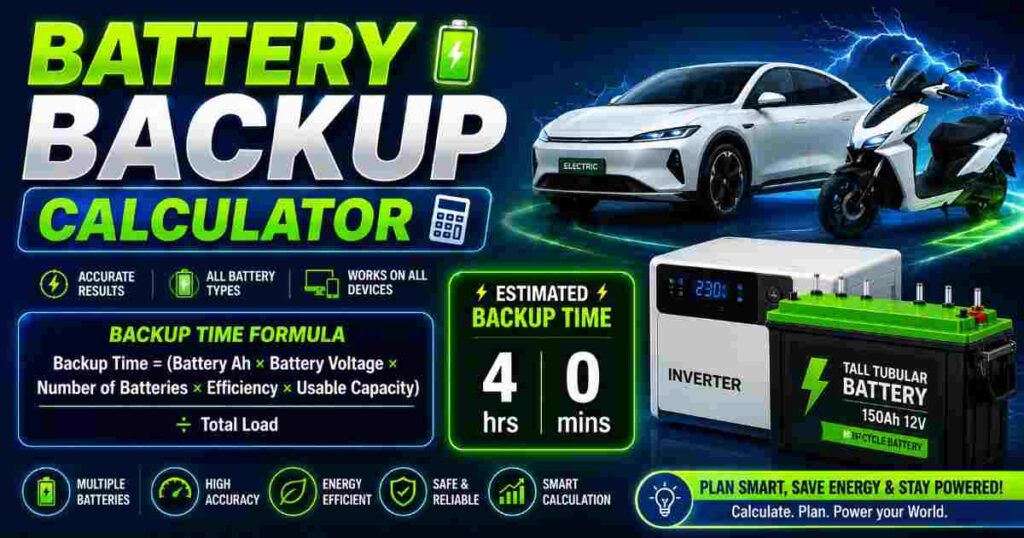
How the UPS/Inverter Backup Calculator Works
For inverter and UPS system, backup time depends on four key factors: battery capacity (AH), battery voltage (V), number of batteries connected, and your total connected load in watt. The calculator also factors in inverter efficiency and usable battery capacity, since no battery discharges 100% of its rated energy in real-world use.
The formula used is:
Backup Time = (Battery AH × Voltage × Number of Batteries × Efficiency × Usable Capacity) ÷ Total Load
For example, a 150Ah, 12V battery running a 300-watt load at 90% efficiency and 90% usable capacity gives routers 4.5 hours of backup – a number that world take several manual steps to calculate otherwise.
How the EV Bike & Car Battery Backup Calculator Works
Electric vehicles work differently. Instead of watts and amp-hours, EV range depends on battery capacity in kWh and energy Efficiency in Wh/km. The calculator also accounts for charging losses and electricity rates, so you get a complete picture: estimated range, cost per kilometer, daily charging cost, and monthly electricity expenses.
Range = (Usual Battery kWh × 1000) ÷ Efficiency (Wh/km)
A typical electricity scooter with a kWh battery and 35 Wh/km Efficiency can travel about 77km on a full usable charge, while an EV car with a 40 kWh battery and 150Wh/km efficiency covers roughly 240 km.
Battery Backup Time Calculation Table
Battery Capacity 100w Load 200W Load 300W Load 400W Load
(AH) (Laptop + Router) (Fans + LED) (TV + 2 Fan +Light) (Fridge-PC)
100 AH 9.6 Hours 4.8 Hours 3.2 Hours 2.4 Hours
120 AH 11.5 Hours 5.8 Hours 3.8 Hours 2.9 Hours
150 AH 14.4 Hours 7.2 Hours 4.8 Hours 3.6 Hours
180 AH 17.3 Hours 8.6 Hours 5.8 Hours 4.3 Hours
200 AH 19.2 Hours 9.6 Hours 6.4 Hours 4.8 Hours
200 AH 19.2 Hours 9.6 Hours 6.4 Hours 4.8 Hours
220 Ah 21.1 Hours 10.6 Hours 7.0 Hours 5.3 Hours
Frequently Asked Questions
Does battery age affect backup time?
Yes, Older batteries loss capacity over time, so actual backup will be lower than a brand-new battery’s rated performance.
Why is usable capacity less than 100%?
Discharging a battery full especially lead-acid types, shortens its lifespan. Most manufactures recommended using 70-90% of rated capacity for longer battery health.
Can I use this for solar battery backup?
Yes, the same Ah × Voltage formula applied to solar battery banks, as you know total connected load.
Whether you’re a home inventor, planning an EV commute, or comparing battery options before a purchase, a reliable battery backup calculator saves time and prevents unpleasant surprise. Try the calculator above to get instant, accurate backup time and range estimates for your specific setup.